
1830–1862
Toronto Necropolis
T10 -24R
James Brown (often recorded as James Browne) holds a grim place in Toronto’s history: he was the last person to be publicly executed in the city. His story is tied to crime, controversy and a turning point in Canadian justice.
Brown was widely alleged to be the leader of the Brook’s Bush Gang, a group accused of terrorizing Leslieville and Don Valley residents during the 1850s.
In December 1859, journalist and politician John Sheridan Hogan disappeared after crossing a bridge over the Don River. Hogan, likely intoxicated, was attacked, robbed and struck on the head before his body was pushed into the icy river. It was more than a year later in March 1861.
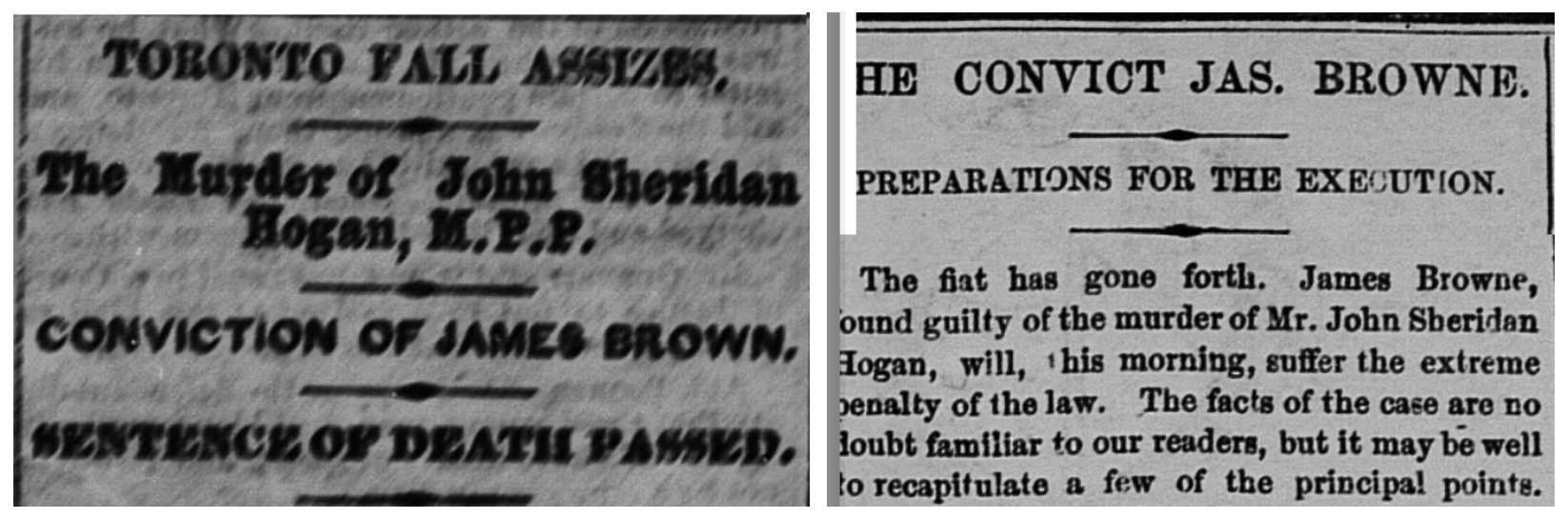
Several suspects were arrested, but only James Brown was convicted, despite what many described as flimsy evidence and Brown’s repeated claims of innocence. His trial became a sensation, reflecting the era’s fears about crime and poverty in a rapidly growing city.
On March 10, 1862, Brown was hanged outside the York County Magistrates Court (now the site of the Adelaide Court House). The event drew an estimated 5,000 spectators, including schoolboys, turning the execution into a public spectacle.
From the scaffold, Brown proclaimed his innocence and urged the crowd to avoid “bad company” and sinful ways. His death marked Toronto’s final public hanging, a practice later banned in Canada in 1870 due to its sensational nature.
Brown’s body was buried in an unmarked grave at Toronto Necropolis. His case remains controversial, raising questions about justice and public punishment in 19th century Toronto.
The end of public executions signaled a shift in attitudes toward law and morality, as society moved away from punishment as spectacle.
Source:
• The Canadian Encyclopedia – “Last Public Hanging in Toronto”
• Wikipedia – Public Executions in Canada
Photo: Item from the October 9, 1861, edition of the Globe; portion of an article from the March 10, 1862, edition of the Globe


