
Toronto Necropolis
Long before Yorkville became a hub of boutiques and cafés, it was home to a six-acre plot referred to as the “Potter’s Field” – Toronto’s first non-denominational burial ground. Established in 1826, it offered a resting place for those excluded from church cemeteries: people of different faiths, the poor and those who had been marginalized by society. As the city expanded to the north, the southeastern corner of the “Woods” – once well outside of town – became Yorkville. Due to this steady municipal growth and the mid-19th century belief that germs and disease came from cemeteries, the cemetery was obliged to close, which it did in 1855.
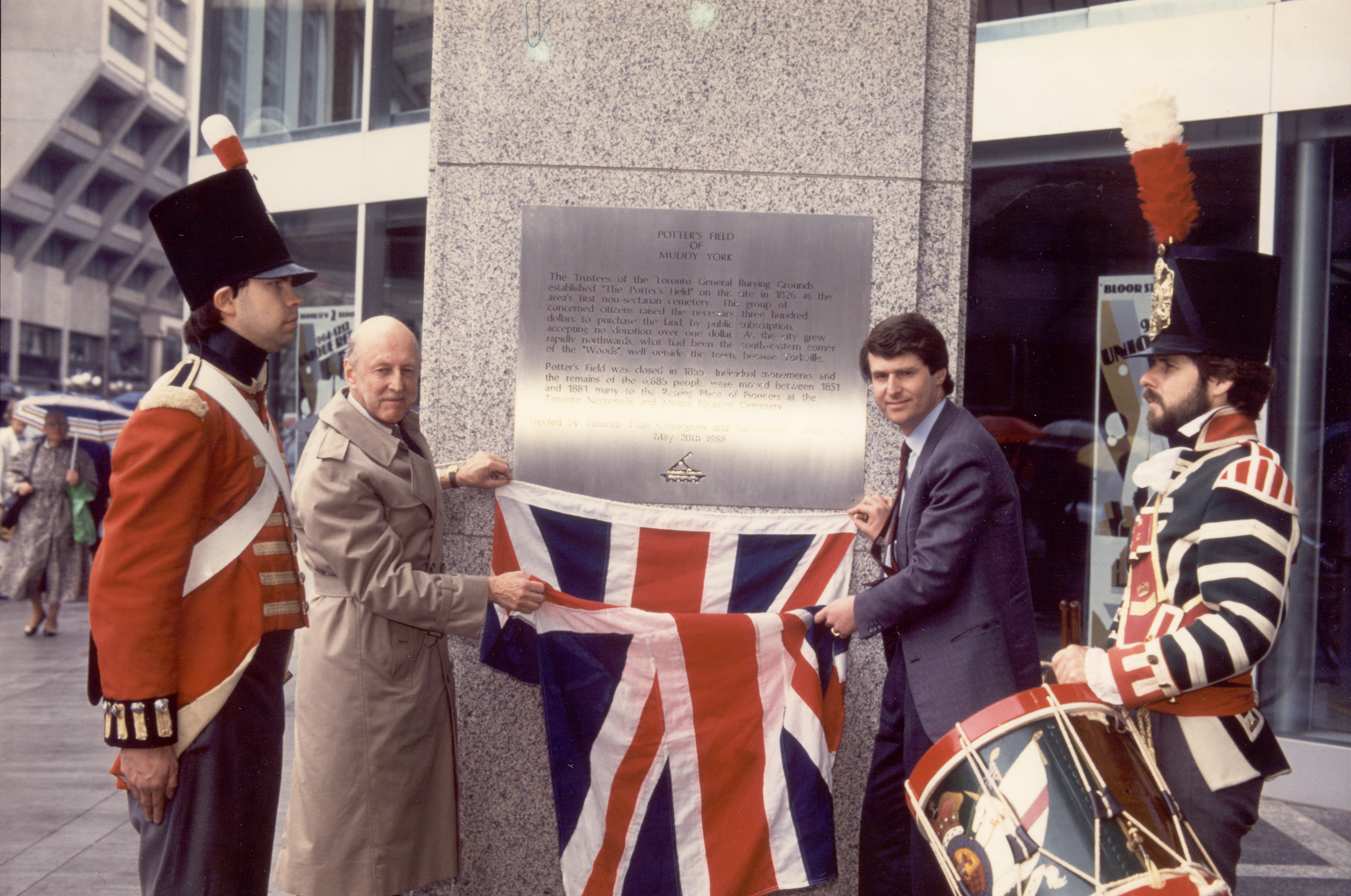
Individual monuments and the remains of the 6,685 people were gradually moved between 1851 and 1881. While records were incomplete and not all individuals could be identified by name, the relocations were carried out under municipal oversight and reflected 19th‑century efforts to balance public health concerns with respect for the dead. Many were reinterred at the Toronto Necropolis and Mount Pleasant Cemetery. A plaque erected by Toronto Trust Cemeteries and Hammerson Canada Inc. was erected at the corner of Yonge and Bloor streets to mark this period of Toronto history.
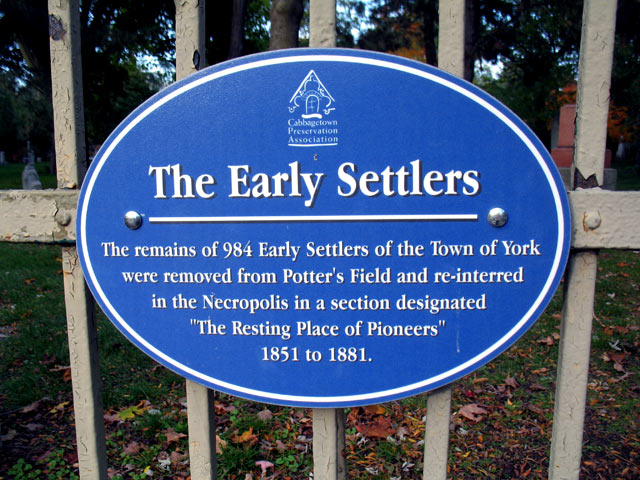
At the Toronto Necropolis, at the corner of Sumach and Winchester Streets, is another plaque which reads “The Resting Place of Pioneers.” The plaque recounts this shift, marking a chapter in Toronto’s history when cemeteries reflected not only grief but also the city’s evolving values of inclusion and remembrance. The Necropolis became a symbolic resting place for Toronto’s “pioneers,” those credited with shaping the young city’s institutions and civic life, while also preserving the memory of thousands whose names were lost but whose stories are nevertheless embedded in the city’s foundation.
Sources:
• Jamie Bradburn – Toronto Cemetery Sojourns: Potter’s Field
• Mount Pleasant Group – History of Toronto’s Early Cemeteries
Photos courtesy of Mount Pleasant Group


