
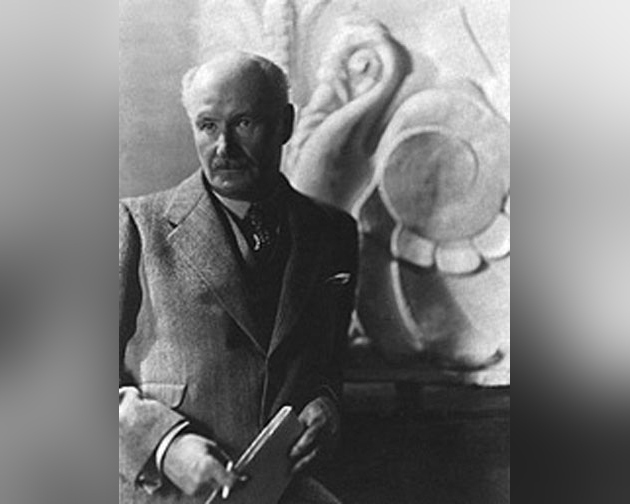
1872-1945
Mount Pleasant Cemetery
Plot 18 Lot 279
John M. Lyle stands as one of the most influential architects in early 20th-century Canada – an artist, thinker and cultural nationalist whose work helped shape the country’s architectural voice. From 1905 to 1943, Lyle designed hundreds of buildings across Canada, many of which still stand as testaments to his vision and craftsmanship. His approach was shaped not only by rigorous training and formidable intellect, but also by a willingness to challenge conventions and embrace new ideas.
Lyle believed that architecture must begin with purpose: that beauty arises from structure; that decoration should follow function, and that a building succeeds only when it embodies clarity, integrity and harmony. He understood monumentality not as mere grandeur, but as a way for architecture to carry shared memory – an idea that would influence many of his civic projects.
Often described as a “progressive traditionalist,” a phrase borrowed from Glenn McArthur’s acclaimed book on his work, Lyle blended classical principles with fresh, forward-looking ideas. His mastery of proportion and light can be felt in spaces such as Toronto’s Union Station, which he co-designed, while his insistence on exceptional craftsmanship is evident in the beloved Royal Alexandra Theatre.
Raised in Hamilton, Ont., Lyle’s artistic journey took him to Yale and then to the École des BeauxArts in Paris – an experience that shaped his life’s work. After refining his skills in New York, where his talent for drawing earned him early recognition, he returned to Canada in his early 30s ready to open his own practice with confidence and ambition.
His portfolio was remarkably broad: homes, banks, churches, theatres, railway stations, memorials, bridges, formal gardens, even urban planning schemes. Lyle often designed interiors along with exteriors – an uncommon level of control that allowed him to unify every detail. He played a key role in the City Beautiful Movement, arguing passionately that Toronto deserved dignified public spaces. He proposed a landscaped Bloor Street viaduct and even envisioned a Paris-style grand avenue stretching from Union Station deep into the city.
A generous mentor and collaborator, Lyle taught, wrote, exhibited, chaired committees and built community within the arts. His friendships spanned from everyday colleagues at a simple Bloor Street diner to members of the Group of Seven seated at his own elegantly appointed dining table.
Perhaps his greatest legacy is his leadership in shaping a distinctly Canadian architecture. He championed the use of Canadian materials, regional symbols and ideas rooted in the landscape itself. He described Canadian architecture as vigorous, bold, individual, scholarly and shaped by climate and place. The Runnymede Library remains one of the finest examples of these ideals – an expression of identity built in brick and stone.
John Lyle transformed European training and international experience into something uniquely Canadian. In doing so, he helped define not only the architecture of his era, but also the cultural identity of a nation discovering its own voice.
His final resting place at Mount Pleasant Cemetery echoes a life spent shaping spaces of shared memory and a distinctly Canadian identity.
Source:
• The Lyle Family
Photo:
• Wikimedia Commons Public Domain


